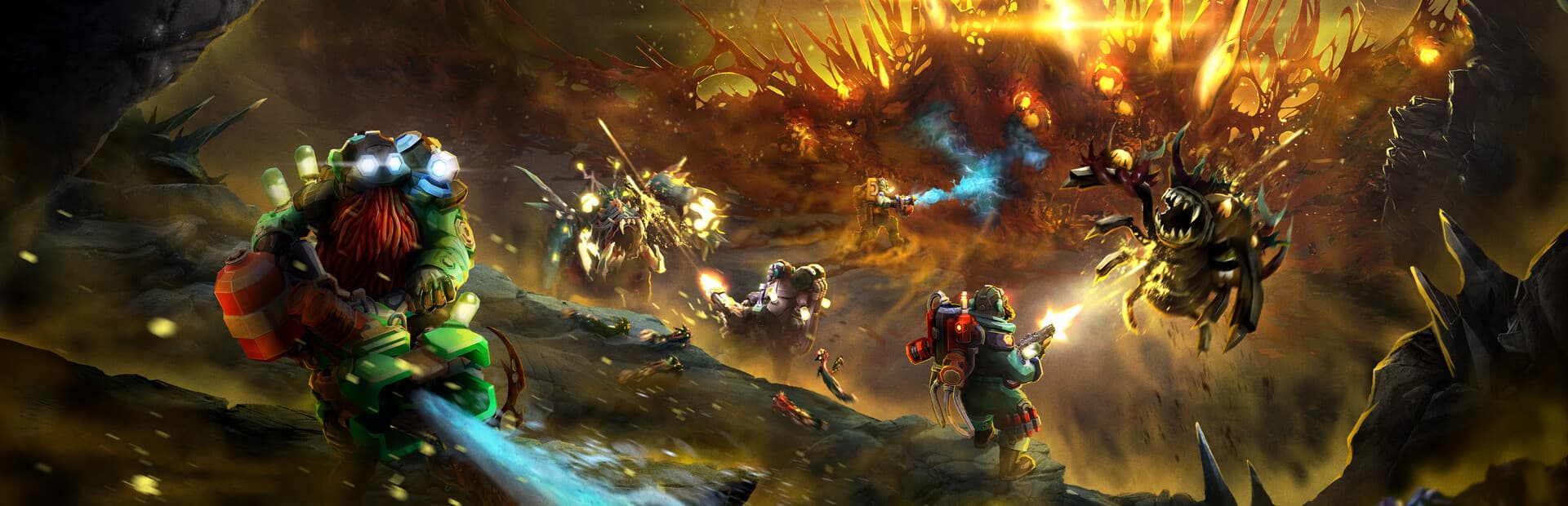
Deep Rock Galactic
Deep Rock Galactic is using the Unreal Engine with technologies like Chromium Embedded Framework, Discord Game SDK, Intel Open Image Denoise, NVIDIA APEX, NVIDIA Ansel, NVIDIA DLSS, NVIDIA Nsight Aftermath, NVIDIA PhysX, OpenVR, OpenXR and Ogg Vorbis.
Deep Rock Galactic is an action-packed 1-4 player co-op FPS developed by Ghost Ship Games and published by Coffee Stain Publishing. It is built using the Unreal Engine and released on Steam on 13 May 2020. It has been positively received by critics, with a Metacritic score of 85.
Engine & Technologies
Unreal Engine
Unreal Engine is a game engine developed by Epic Games, first showcased in the 1998 first-person shooter game Unreal. Although primarily developed for first-person shooters, it has been successfully used in a variety of other genres, including platformers, fighting games, MMORPGs, and other RPGs.
Chromium Embedded Framework
Framework for embedding Chromium-based browsers in applications, often used for in-game UI.
Discord Game SDK
Integration SDK for Discord rich presence, voice chat, and social features in games.
Intel Open Image Denoise
AI-based denoising library that significantly improves rendering quality by removing noise from ray-traced images.
NVIDIA APEX
Physics-based effects SDK for destruction, clothing simulation, and particle systems in games.
NVIDIA Ansel
In-game photography tool allowing players to capture professional-quality screenshots with filters and super resolution.
NVIDIA DLSS
Deep Learning Super Sampling technology that uses AI to boost frame rates while maintaining image quality.
NVIDIA Nsight Aftermath
GPU crash analysis tool that helps developers diagnose and fix GPU hangs and crashes.
NVIDIA PhysX
Real-time physics engine providing rigid body dynamics, soft body simulation, and GPU-accelerated physics.
OpenVR
API for virtual reality hardware access, providing a common interface for VR headsets and controllers.
OpenXR
Open standard for VR and AR applications, providing a unified API across different XR hardware.
Ogg Vorbis
Open source, patent-free audio compression format commonly used for game audio.